How money moves through Craze City
In most life sims money has exactly one thing it can do, which is leave. Giving it somewhere to sit is what turned a number into a decision.
· 4 min read · Brainbaby Labs · Updated
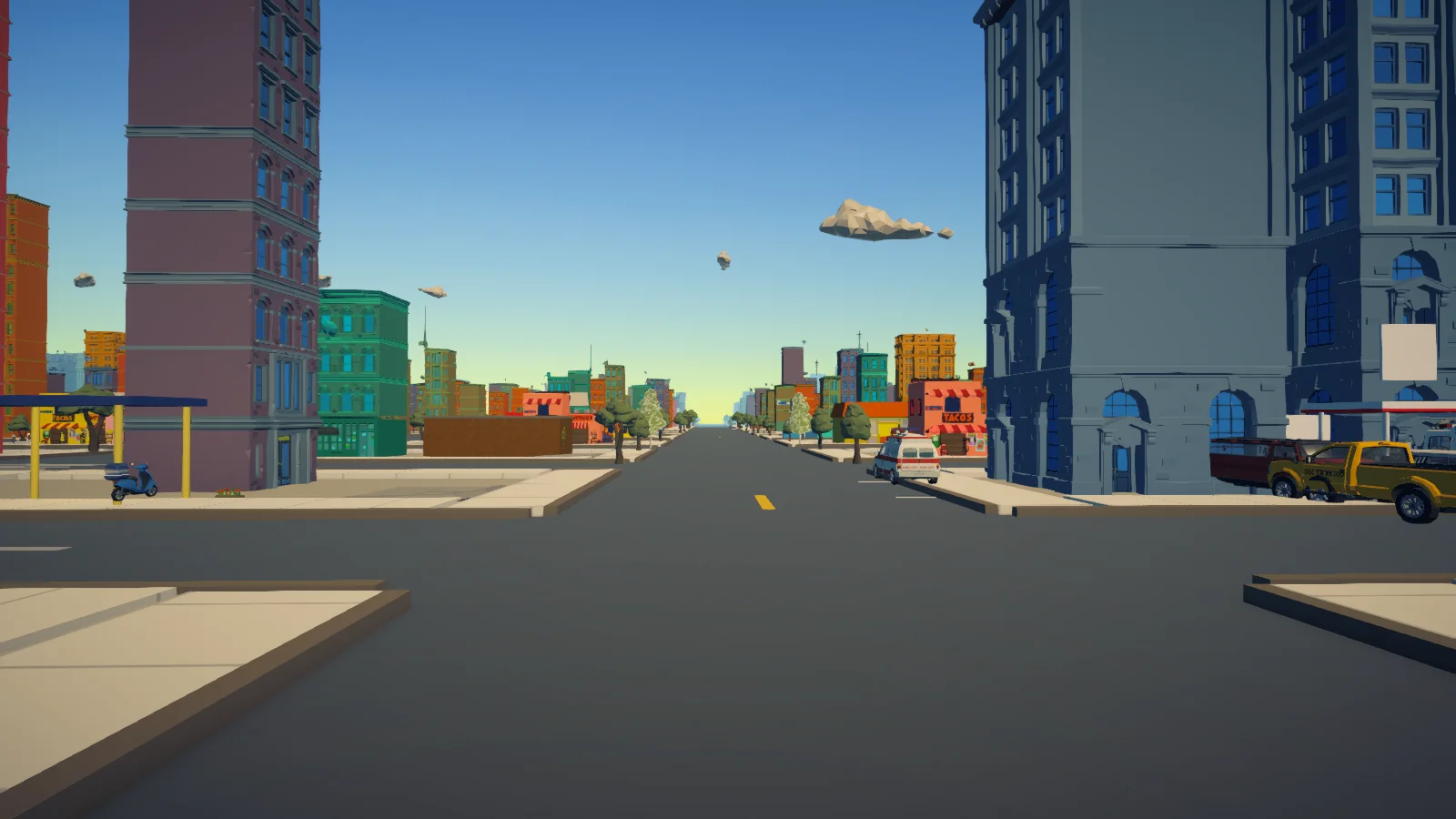
A wallet is not an economy
Most life sims give you a number. Work raises it, buying lowers it, and between those two events nothing happens to it at all. That is a scoreboard, not an economy — the money has one available action, which is to leave.
The test we ended up using: can a player make a decision about money without spending it? Across most of the genre the answer is no, and getting to yes is the reason Craze City has a bank sitting in the middle of it rather than a shop.
Three places money can be
Money in Craze City is always somewhere specific, and which somewhere is a choice you remake several times a session. The three options behave differently on purpose:
- Your wallet
- Liquid, spendable anywhere in the city, and the money that travels with you. It is also the money at risk the moment you cross the bay.
- The Craze Bank
- Savings pay interest every minute you are in the city, on the first slice of the balance rather than on all of it. Street ATMs are spread along the avenues rather than clustered at spawn, so the safe option is a short walk rather than a trip across town.
- Assets
- Property, a business, a garage. A shop's till earns while you are out, and a flat can be furnished, upgraded, rented or flipped. Slow to turn back into cash, which is what owning things costs.
The rule that gives the bank a job
A savings account in a game is decoration unless not using it can cost you something. Deadwood Quarantine is what costs you.
Hazard pay in the quarantine rises the deeper and longer you stay, and it only becomes yours when you walk back across the bridge. Go down inside and everything unbanked is gone. That one rule converts "is my money in the bank" from a menu item into a question you ask yourself before you leave the city.
It also means the bank is not the dull safe corner of the game, sitting off to one side of the interesting part. It is the counterparty to the riskiest thing in it. Neither is worth much without the other.
Interest is a clock, and it runs while you play
Savings tick up on a fast arcade clock — minutes, not days — for as long as you are in the city. That is a real design decision with a real cost attached, and it is worth being straight about both halves.
The upside is that a life sim about building something should reward the thing you built. An account that has moved since you last looked at it is the clearest possible signal that what you own is yours and still working — a signal no amount of interface can fake.
The cost is that the safest option in the game also earns, which means every risky thing in the city now has a rate to beat or nobody would ever leave the house. That pressure is visible everywhere else in the design: hazard pay in the quarantine scales with depth rather than sitting flat, the Street Sprint has a podium that pays, and every career levels. A floor that earns quietly forces the ceiling up.
Loans that do not forgive
You can borrow from the Craze Bank: one starter loan at a time, at a single flat fee quoted before you accept it.
A loan that costs nothing is not really a loan. It is a slower way to print money, because there is nothing on the other side of it — at worst you ignore it and carry on. A compounding one is the opposite failure: it punishes hardest the player who needed it most, which is a debt spiral wearing a game's clothes. One flat fee, quoted before you take it and not a cent more, is the version that stays a decision — you know the whole price at the moment you make it, and you cannot borrow again until it is settled.
So the loan desk is not there to hand you cash. It is there to let you move on a deal before it is gone, at a price you can actually feel.
The closed loop is what makes any of it real
None of the above survives a shop. If the number can be bought, then choosing where to put it stops being a decision and becomes a delay — a thing you route around with a card.
Craze City has no in-app purchases at all: no loot boxes, no gem shop, no currency packs, no price tag anywhere in the game. Gems are earned in-game and never sold. It is a closed loop with no cash-out and no real-money lending, so nothing enters the economy that was not worked for inside it.
That normally gets framed as a consumer-friendly decision, and it is one. It is also the beam holding the economy up. The only reason a savings balance means anything is that every unit in it was earned, by you, in a city where nobody could pay to skip past you.
What it changes to play
The question a life sim usually asks is how much have you got. Craze City asks a duller-sounding one that turns out to be much harder to answer: where is it.
Wages, tips and rent land in your wallet, and every wage, rent payment, loan and trade clears through it. On any given evening you are deciding how much to leave liquid for a car you have been circling, how much to lock away before you go and do something stupid across the bay, and how much to put into something with a till in it.
That is three decisions a scoreboard cannot ask you to make.