A city you can enjoy on your own
Say a game is online and half the people reading decide it is not for them. They are usually right, and the reason is not the other players.
· 3 min read · Brainbaby Labs · Updated
Playable alone is not a promise, it is a spectrum
Almost every shared-world game will tell you it can be played solo, and almost none of them are lying. You can log in on your own and things will happen. The question that actually decides whether you enjoy it is a different one: what was the game tuned for.
There are three usual ways the answer turns out to be 'not you'. Content is gated behind a party, so the interesting half of the game is a menu that says you need three more people. Difficulty is set for a group, so alone you are playing the same fight with a quarter of the output. Or the world is a lobby with the furniture out, and nothing moves unless a person moves it.
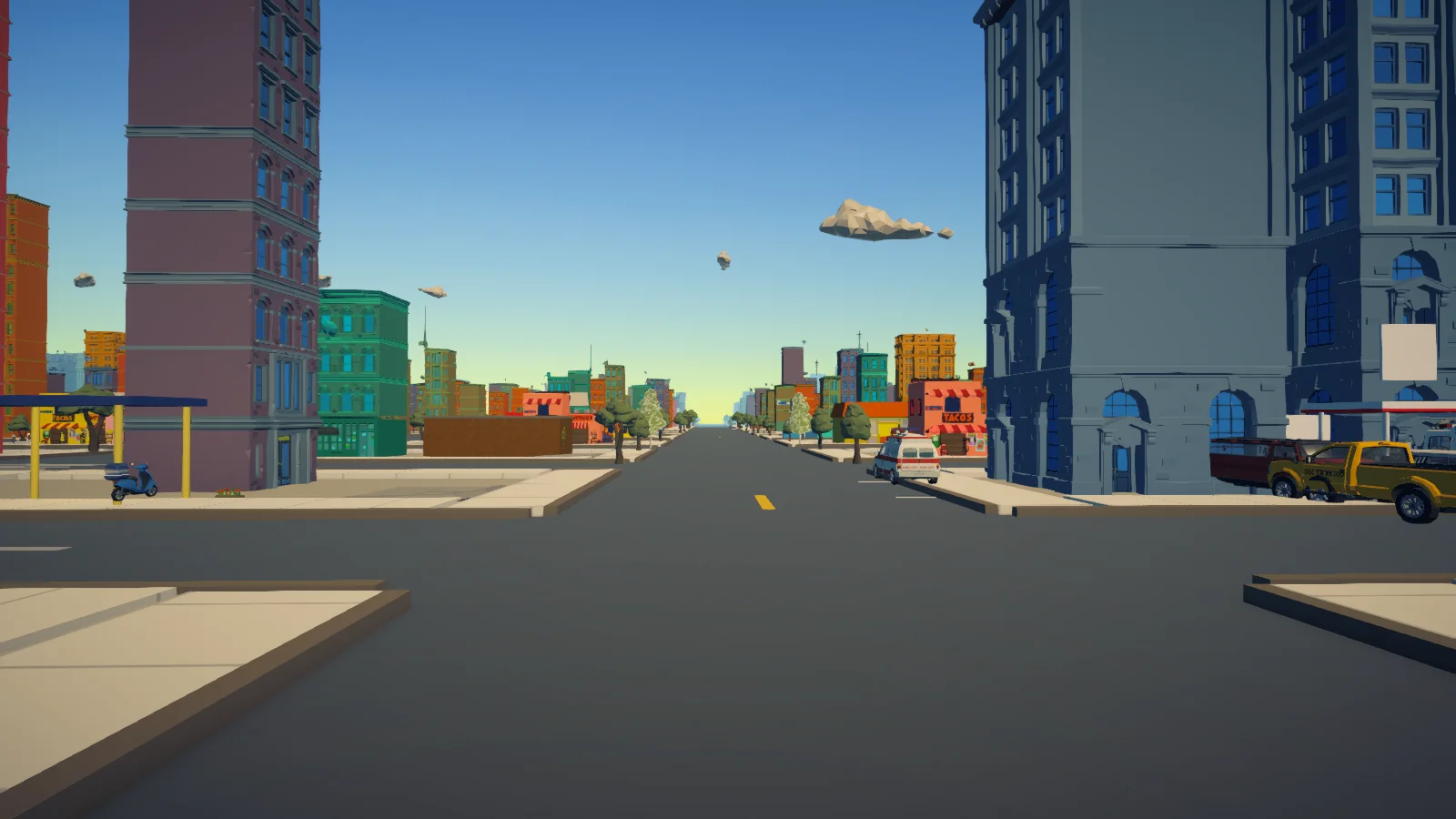
The third one is the quiet killer. A city with nobody in it does not feel peaceful, it feels cancelled.
The rule we hold instead
Nothing in Craze City scales with how many people you brought. That is the whole commitment, and it is deliberately phrased as a restriction on us rather than a feature for you, because that is what it is: a thing the design is not allowed to do.
In practice it means the city is populated by its own systems rather than by its population.
- The crowds and the traffic
- Built by the world itself when it boots. Neither one asks whether anyone else is connected.
- The police
- They answer your heat. Not a lobby's heat, not a shared alert level — the trouble you personally caused.
- The rival racers
- Spawned by the race. A street race with one human in it is still a street race with a field.
- The island
- Deadwood Quarantine scales on depth and on nothing else. There is no player-count term in it anywhere.
That last one is the load-bearing case
A zombie zone is exactly where a game normally reaches for party scaling, because it is the easiest lever in the building: more players, more infected, everyone stays busy. It is also the lever that makes solo play feel like a punishment, because the tuning it produces has a group in mind and you are not one.
The horde here scales on how deep you have pushed and that is the entire input. Walk in alone and the wall is the same wall. Push to the same depth with three friends and you have made it easier, which is the correct direction for a decision you chose to make, rather than the game quietly re-balancing to erase the advantage of having company.
What holding the rule costs
It rules out the whole category of content that only works because coordination is hard. No encounter can require four people covering four positions, because a solo player has to be able to attempt it, and 'attempt it and lose' is not the same as 'be locked out'.
It also means we cannot use party size as a difficulty knob, which is genuinely the cheapest one available. Everything has to be tuned against a single competent player, and the group experience has to come from somewhere other than the numbers — from splitting up, covering more ground, and being able to carry each other out.
The honest summary is that friends make Craze City better and they are not the price of entry. The shared city is the point, and it is built so that turning up alone is a way to play it rather than a way to miss it.
Worth checking in anything else you are looking at
Two questions get you most of the way, and both are answerable before you commit an evening.
Does difficulty change with party size, and is any content gated behind a minimum number of players. A yes to either tells you what the game was tuned for, whatever the store page says about solo support.
Craze City is an online open-world life sim for mobile and it has not launched yet. The waitlist is how you hear when it does.