Building a connected city for your phone
Every mobile open world promises one city. Most of them deliver five districts and a progress bar. The difference is not budget or art, it is where the world comes from.
· 3 min read · Brainbaby Labs · Updated
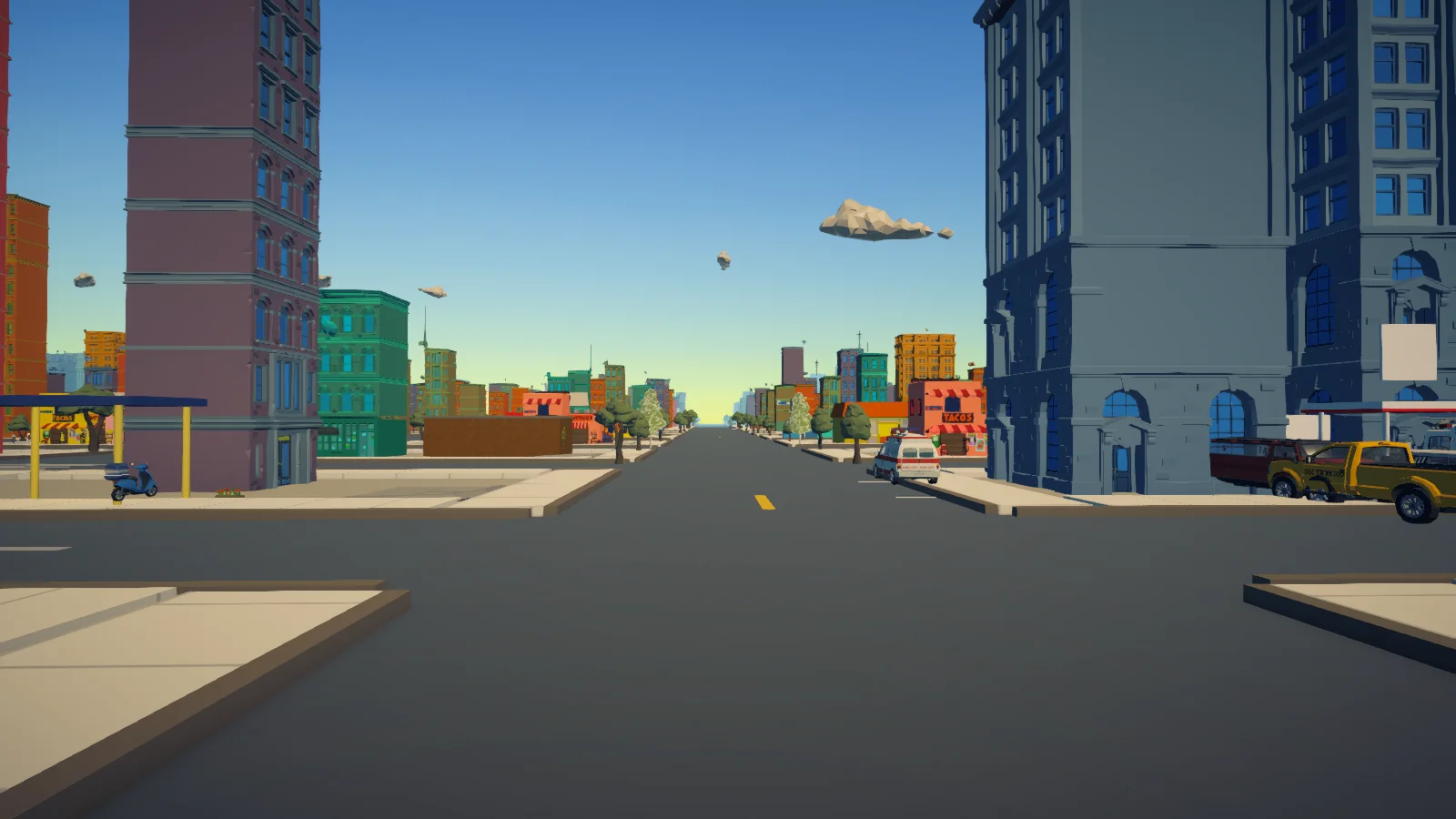
The loading screen is a memory confession
When a mobile game puts a progress bar between two districts, it is telling you something specific about how it was built: the districts are separate files, only one of them fits in memory, and the bar is the time it takes to throw the first one away and read the second one off storage.
That is not laziness. A phone gives a game a hard memory ceiling and kills it without ceremony for going over. Splitting the world into chunks that each fit under the ceiling is the straightforward way to stay alive, and it is why so many games described as open world turn out, once you play them, to be a set of rooms with corridors between them.
The cost is not really the wait. It is that the seam becomes a design boundary. A police chase cannot cross a loading screen. Neither can a friend.
Craze City does not ship a map
The city is not a file the game downloads and streams. It is generated on the device from the game's own rules at boot, which is a genuinely different arrangement and has three consequences worth spelling out.
There is no level to download, so the install is not carrying a city. There is no authored chunk boundary, because nobody drew the chunks. And what lives in memory at any moment is a function of where you are standing rather than which file happens to be open.
- No download
- The world is built on your phone rather than fetched. The install size is the game, not the map.
- No authored seams
- Districts are not separate assets, so there is no boundary between them for a chase or a friend to fail to cross.
- Position, not files
- What is resident is decided by where you are, which is the thing that actually predicts what you are about to need.
This buys one specific thing
It buys continuity, and continuity is the whole reason anyone wants an open world in the first place.
You can take a taxi fare from downtown, get pulled over on the way, lose the car, walk to the bay, and get on a boat to the quarantine island, and at no point does the game stop and ask you to wait while it fetches the next part of itself. The run is one continuous thing because the city is one continuous thing.
It also means the city can be busy in the background. Traffic, crowds and police do not have to be torn down and rebuilt every time you cross a boundary, because there is no boundary to cross.
What it costs, honestly
Generated worlds have a reputation, and it is mostly deserved: they can feel samey, because a rule that can build a street anywhere tends to build the same street everywhere.
The answer is not to abandon generation, it is to author the parts that carry meaning and generate the parts that carry distance. Landmarks, the bank, the waterfront and the bridge to the island are placed rather than rolled. The blocks between them are generated, because their job is to be a city you drive through, not a city you photograph.
The second cost is that boot has to do real work before you can play. A game that reads a finished map can start showing it almost immediately; a game that builds one has to build it. That is a budget we spend deliberately, once, instead of spending it in smaller pieces every time you cross a district line.
How to tell, from outside
You cannot read a store listing and know which of these a game is. But you can check three things in the first ten minutes, and they are reliable.
Does the map have named regions that always load separately. Does fast travel show a progress bar, or does the world simply move. And can something in progress — a chase, a timer, a friend following you — survive crossing the map. If the answer to the last one is no, the world is a set of rooms, whatever the description says.
Craze City is an online open-world life sim for mobile built the other way, and it is not out yet — this is a description of how it is made, not a review of something you can install tonight.