Make your character feel like you
Most character creators are a shop with a mirror attached. The interesting question is not how many hairstyles there are, it is what wearing one tells anybody.
· 3 min read · Brainbaby Labs · Updated
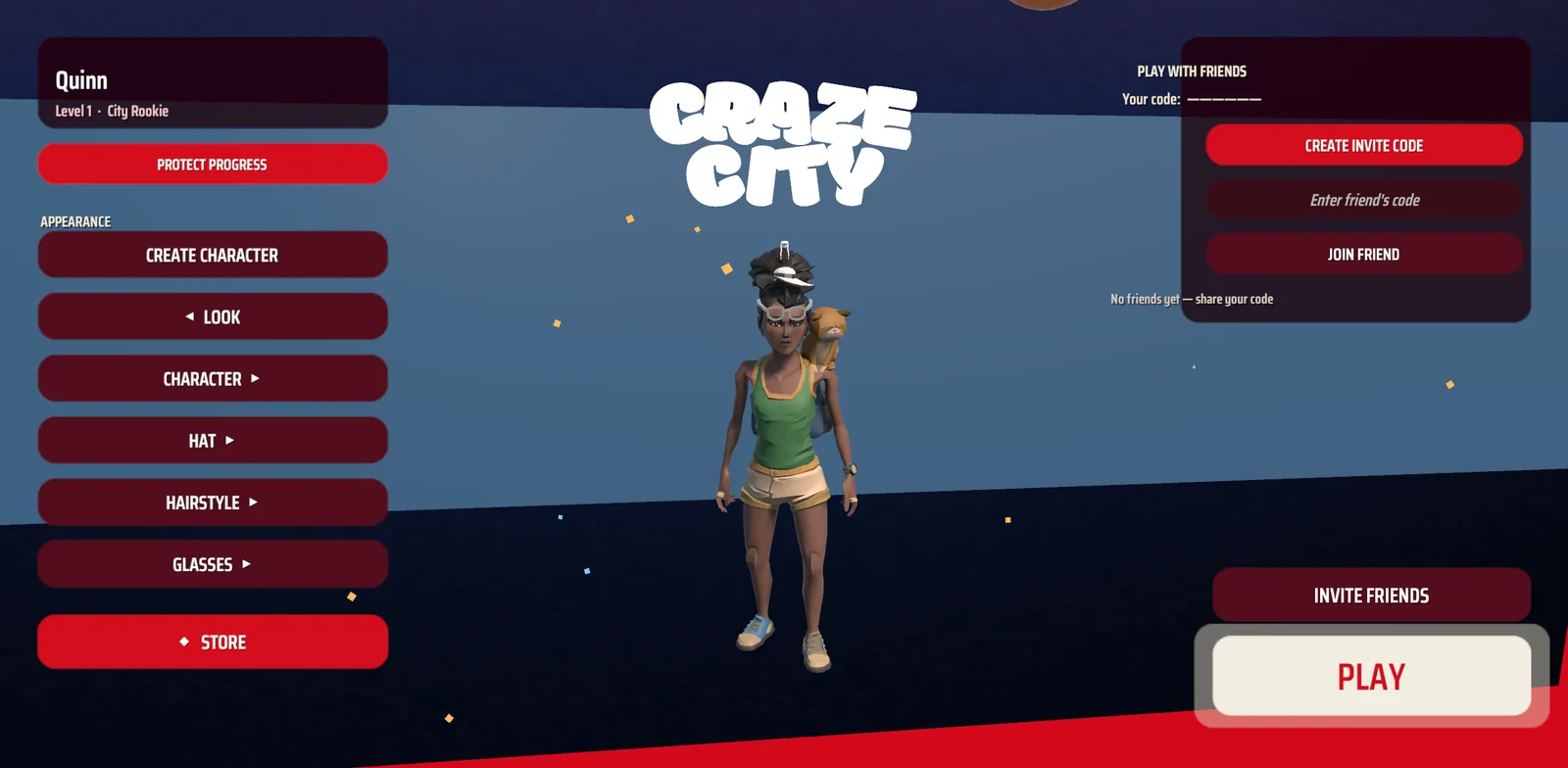
A cosmetic is a sentence about you
In a game other people can see you in, what you are wearing is communication. It is the first thing another player reads, it is read instantly, and it is read before you have done anything.
Which means a cosmetic is only interesting to the extent that it is hard to be wrong about. If a jacket means 'this person got to the top of the racing ladder', seeing it tells you something. If it means 'this person had four pounds', seeing it tells you about their bank, and everybody stops looking.
That is the actual failure of most customization systems, and it is not an ethical failure, it is an information one. The catalogue gets bigger every season and each new item says less than the last, because the only thing any of them can prove is that a payment went through.
So the rule is that you cannot buy any of it
Every cosmetic in Craze City is bought with money the player worked for, and the game's second currency is earned by playing rather than sold. There is no gem pack, no price tag on anything, and no card involved anywhere.
The consequence is the part worth caring about: an outfit becomes evidence. It cost somebody shifts, or a race, or a run out to the quarantine island and back across the bridge with the money still on them. When you see it, you are reading a history rather than a receipt, and that is what makes looking at other players worth doing at all.
What this forces on the design
Holding that rule is not free, and it lands hardest on the parts of a live game that usually run on the shop.
- Everything needs a source
- An item cannot just exist in a catalogue. Something in the city has to hand it over, which means every cosmetic is also a piece of content design.
- The catalogue grows slowly
- A shop can add fifty items in an afternoon. Fifty earnable items is fifty reasons to play, and those take real work to be worth doing.
- Rarity has to be honest
- If an item is described as hard to get, it has to actually be hard to get, because there is no second path where money quietly resolves it.
- No season pass shortcut
- The usual fix for a thin reward loop is to sell the loop. That option is off the table, so the loop has to be good.
The creator itself is the smaller half
Sliders matter less than people expect. A creator with enormous range and nothing to earn produces a city where everyone looks different and nobody looks like anything, because appearance is disconnected from what anyone did.
The starting point is deliberately modest for that reason: enough to make somebody recognisably yours before you set foot outside, and then the interesting variation arrives through play. Your look is a running total rather than a decision you made once at the beginning, which is also the reason the wardrobe is worth opening again after week one.
The economic version of this argument, about property rather than clothes, is in a house has to change how you play, and the wider monetisation position is in mobile games with no in-app purchases.
What to look for elsewhere
One question separates a customization system from a storefront with a preview window: can the best-looking item in the game be obtained without spending money, and if so, by doing what.
If the answer is a specific activity, the cosmetics carry information. If the answer is a currency you can top up, they carry a balance.
Craze City is an online open-world life sim for mobile and it has not launched. This is the rule the wardrobe is being built to, not a tour of one you can open tonight. The waitlist is how you hear when it does.